The text proposes to punish anyone who commits an “unnatural act” with up to fifteen years in prison, whereas the Penal Code already provides for a sentence of one to five years.
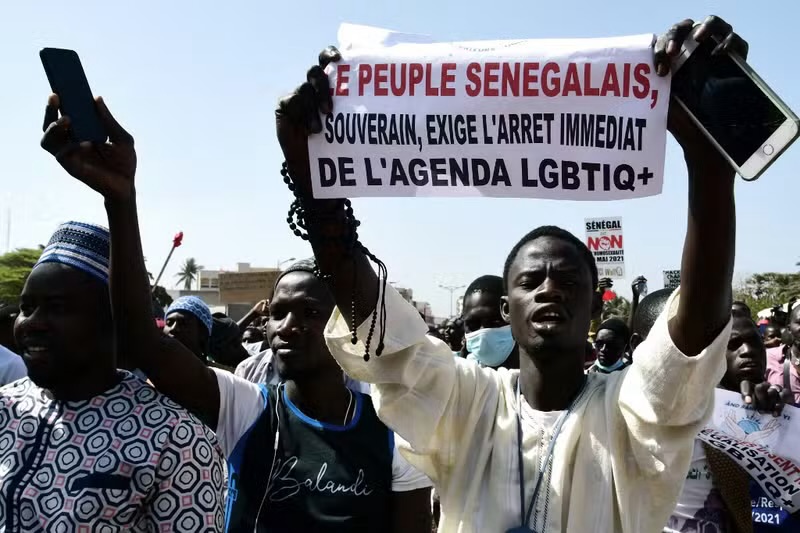
The issue of criminalizing homosexuality is once again being debated within the walls of the Senegalese National Assembly. On Monday, June 24, a member of parliament tabled a bill aimed at tightening existing legislation. In theory, the initiative enjoys broad support from the public, the House of Representatives, and the executive, since Prime Minister Ousmane Sonko, while still in opposition, promised in 2022 that this would be one of the first laws he would pass if he came to power. However, in practice, the adoption of this proposal by Parliament is proving delicate, as it could destabilize some of Senegal’s diplomatic relations.
Until now, Article 319.3 of the Penal Code provides for imprisonment of one to five years and a fine of 100,000 to 1,500,000 CFA francs (€150 to €2,200) for anyone committing an “unnatural act with a member of the same sex.” But MP Cheikh Abdou Bara Dolly Mbacké, from the Liberté démocratie et changement parliamentary group, which is sponsoring the bill, wants to go further. “We must fight against the perversion of morals in our society, against these immoral cultural values imported from the West,” says the elected official, who joined the Diomaye Président coalition before Bassirou Diomaye Faye’s presidential victory in March. The text therefore provides for a sentence of ten to fifteen years in prison and a fine of 1 to 5 million CFA francs and would establish “offenses of bisexuality, transsexuality, necrophilia and bestiality.” In one month, this is the second proposal submitted to the National Assembly aimed at toughening legislation on homosexuality.
“External injunctions”
Furthermore, the text by MP Cheikh Abdou Bara Dolly Mbacké almost entirely reproduces the provisions of a previous proposal, which dates from 2022. Submitted to the vote of the deputies, it was rejected by the presidential majority at the time, which considered that the legislation was already “clear and precise” on the subject, and that there was no need “to add or remove a comma”.
In an unchanged National Assembly, Cheikh Abdou Bara Dolly Mbacké nevertheless believes that his bill can now pass. “In 2022, this law was not passed because President Macky Sall’s regime blocked it in the face of Western pressure,” he asserts. “Today, it’s different; we have a prime minister who, I believe, will not give in to external pressure.”
In mid-May, during a conference in Dakar with Jean-Luc Mélenchon on relations between Africa and Europe, Prime Minister Ousmane Sonko warned Westerners that their activism on behalf of homosexuals and sexual minorities could provoke a “new casus belli” with his country. It was also an opportunity for him to denounce the fact that “the issue of gender regularly comes up in the programs of most international institutions and in bilateral relations, often even as a conditionality for various financial partnerships.” Nevertheless, this proposed law embarrasses the new government. “Sooner or later, we will move towards this type of legislation,” said an advisor to the Prime Minister. “Today may not be the right time.” The same sentiment was echoed by members of parliament from the African Patriots of Senegal for Work, Ethics, and Fraternity (Pastef), the presidential party, and the Yewwi Askan Wi coalition.
“Determined”
The new proposal, while capable of satisfying a conservative electorate, could nevertheless have international consequences and disrupt Dakar’s diplomatic relations with Western foreign ministries, or even deprive it of certain institutional funding. For example, the World Bank has twice suspended its payments to Uganda after it adopted laws criminalizing homosexuality. The same threat now hangs over Ghana, which toughened its laws in February.
“The executive is caught between its promises and the reality of exercising power,” comments Xalima, an LGBT rights activist living in exile in France. While the adoption of this law seems uncertain, the concerns of the LGBT community in Senegal are very real. “The country has become unlivable, to the point that every day we see people from the community leaving for neighboring states,” says Xalima.
With the annual parliamentary session scheduled to end on Sunday, it seems “unlikely” that the vote will take place by then, according to the chairman of the Law Commission, Moussa Diakhaté. “We will resume parliamentary work in the first half of October,” he announced. Unless an extraordinary session is convened during the summer.

 Planète Queer